



0,60€
Auf Lager

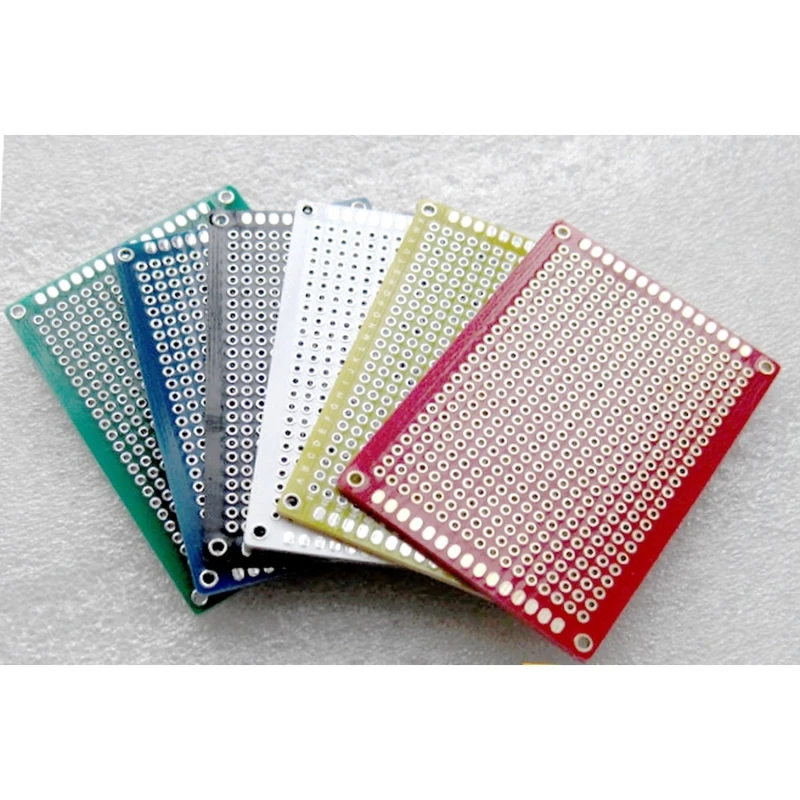
5x7cm Lochrasterplatine grün für Elektronikprojekte
Marke: satkit
0,60€
Inkl. MwSt. (Exkl. MwSt.: 0,50€)
Auf Lager - Sofort versandfertig
Standardlieferung
Mi, Apr 22 - Fr, Apr 24
Expresslieferung
Mo, Apr 20 - Di, Apr 21
30 Tage Rückgaberecht
Kostenlose Rücksendung innerhalb von 30 Tagen
Sichere Transaktion






Share:
Kostenlose Lieferung
Bei Bestellungen ab 300€
Einfache Rücksendung
30 Tage Rückgaberecht
Sichere Zahlung
100% sicherer Checkout
Qualitätsgarantie
Nur Originalprodukte
Die 5cmx7cm Lochrasterplatine in Grün ist ein unverzichtbares Bauteil für jeden Elektronik-Hobbyisten oder Profi, der Prototypen oder Schaltungen einfach und zuverlässig aufbauen und testen möchte.
Diese Platine besteht aus einer Kunststoffplatte aus Bakelit, einem Material, das für seine Härte und Wärmebeständigkeit bekannt ist und sich ideal eignet, um elektronische Bauteile zu montieren, ohne sich zu verformen. Die grüne Farbe erleichtert die Sicht auf Schaltungen und Lötstellen.
- Größe: 5cm x 7cm, ein kompaktes Format, das Arbeiten an verschiedenen Projekten ermöglicht, ohne viel Platz zu beanspruchen.
- Stärke: 1.2 mm, was eine solide und stabile Basis für die Montage bietet.
- Bohrungsanordnung: Die Pads befinden sich auf einer Seite, mit einem Standardabstand von 2,54 mm zwischen den Bohrungen, kompatibel mit den meisten elektronischen Bauteilen und Arduino-Pins.
- Bohrungsdurchmesser: 1.0 mm, geeignet für das Löten und Montieren von Kabeln und Pins.
Diese Platine ist ideal für den Aufbau elektronischer Prototypen, Reparaturen und Schaltungstests. Ihre Kompatibilität mit Standardbauteilen macht sie perfekt für Projekte mit Arduino, Mikrocontrollern und anderen elektronischen Systemen.
Hinweis: Das Produkt ist derzeit nicht auf Lager. Wir empfehlen, Alternativen zu prüfen oder sich für eine Benachrichtigung bei Verfügbarkeit anzumelden.
- Kompaktes Format 5cm x 7cm für Elektronik-Prototypen
- Robustes Bakelit-Material mit 1.2 mm Stärke
- Bohrungen mit 1.0 mm Durchmesser und 2,54 mm Standardraster
- Grüne Farbe für bessere Sichtbarkeit und übersichtliche Schaltungen
- Kompatibel mit Standard-Bauteilen und Arduino-Projekten
Kundenfragen & Antworten
What is the main advantage of the bakelite board compared with fibreglass (FR4) boards for prototyping?
The bakelite board is cheaper and easier to cut or drill than a fibreglass (FR4) board, although FR4 offers greater mechanical and thermal resistance. For simple prototypes or educational use, bakelite is suitable thanks to its low cost and ease of handling.
What types of components and pin thicknesses are compatible with the 1.0 mm diameter holes?
The 1.0 mm holes are compatible with most standard through-hole (THT) electronic components, whose pins are usually between 0.4 mm and 0.8 mm in diameter. Components with thicker pins may not fit properly.
Does the board surface require any special treatment before soldering components?
The copper surface of the board is normally ready to solder, but it may oxidise over time. It is recommended to clean it with isopropyl alcohol or an abrasive eraser before soldering to ensure better adhesion.
What is the dimensional tolerance of the board, and how can it affect repetitive project assembly?
The typical tolerance for this type of board is ±0.5 mm on linear dimensions. For batch assemblies requiring precise component positioning, manual adjustment may be necessary.
Does the board comply with any safety or fire-resistance standard?
Bakelite offers some heat resistance, but these boards are not certified under international standards (such as UL94) for flame retardancy. They are not recommended for critical applications where there is a fire risk.
What is the main advantage of the bakelite board over fibreglass (FR4) boards for prototyping?
The bakelite board is cheaper and easier to cut or drill than fibreglass (FR4), although FR4 offers greater mechanical and thermal resistance. For simple prototypes or educational use, bakelite is suitable due to its low cost and ease of handling.
What types of components and pin thicknesses are compatible with the 1.0 mm diameter holes?
The 1.0 mm holes are compatible with most standard through-hole (THT) electronic components, whose pins are usually between 0.4 mm and 0.8 mm in diameter. Components with thicker pins may not fit properly.
Does the board require any special treatment of the surface before soldering components?
The copper surface of the board is normally ready for soldering, but it may oxidise over time. It is recommended to clean it with isopropyl alcohol or an abrasive eraser before soldering to ensure better adhesion.
What is the dimensional tolerance of the board and how can it affect repetitive project assembly?
The typical tolerance for this type of board is ±0.5 mm in linear dimensions. For production runs that require precise component positioning, manual adjustment may be necessary.
Does the board comply with any safety or fire-resistance standards?
Bakelite offers some heat resistance, but these boards are not certified under international standards (such as UL94) for flame retardancy. It is recommended not to use them in critical applications where there is a fire risk.
Kundenbewertung schreiben
Kunden, die diesen Artikel gekauft haben, kauften auch
Ihre zuletzt angesehenen Artikel

 5x7cm Lochrasterplatine grün für Elektronikprojekte
0,60€