


2,98€
Auf Lager


16x5cm Breadboard mit 830 Punkten für Elektronikprojekte
Marke: satkit
2,98€
Inkl. MwSt. (Exkl. MwSt.: 2,50€)
Auf Lager - Sofort versandfertig
Standardlieferung
Mi, Apr 22 - Fr, Apr 24
Expresslieferung
Mo, Apr 20 - Di, Apr 21
30 Tage Rückgaberecht
Kostenlose Rücksendung innerhalb von 30 Tagen
Sichere Transaktion






Share:
Kostenlose Lieferung
Bei Bestellungen ab 300€
Einfache Rücksendung
30 Tage Rückgaberecht
Sichere Zahlung
100% sicherer Checkout
Qualitätsgarantie
Nur Originalprodukte
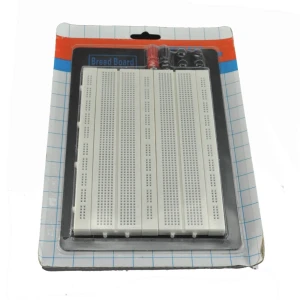
Die 16x5cm Breadboard mit 830 Punkten ist ein unverzichtbares Werkzeug für alle Elektronikbegeisterten und Profis, die Schaltungen ohne Löten aufbauen und testen möchten. Diese Breadboard bietet eine großzügige, übersichtliche Fläche, um elektronische Bauteile temporär und sicher zu verbinden.
Wichtige Eigenschaften:
- Größe: 16x5 cm, ideal für kompakte und mobile Projekte.
- Kontaktpunkte: 830 Punkte für vielfältige Verbindungen und komplexe Prototypen.
- Selbstklebende Basis: Inklusive Klebestreifen zur Befestigung der Platine auf Oberflächen und zur Vermeidung unerwünschter Bewegungen während des Aufbaus.
- Seitliche Verbinder: Ermöglicht das Verbinden mehrerer Platinen, um die Arbeitsfläche je nach Projektanforderung zu erweitern.
- Hohe Qualität: Robuste Materialien für Langlebigkeit und guten elektrischen Kontakt.
Typische Anwendungen:
- Schnelles Prototyping von elektronischen Schaltungen ohne Löten.
- Tests und Entwicklung von Projekten mit Arduino und anderen Mikrocontrollern.
- Elektronikunterricht und Lernen für Schüler und Einsteiger.
- Temporäre Aufbauten für Experimente und Vorführungen.
Kompatibilität: Diese Breadboard ist mit den meisten gängigen elektronischen Bauteilen kompatibel, darunter Widerstände, Kondensatoren, LEDs, Transistoren und Module für Arduino.
Dank des modularen Designs und der selbstklebenden Basis lassen sich individuelle und stabile Konfigurationen für jedes Elektronikprojekt erstellen. Die 16x5cm Breadboard mit 830 Punkten ist ein unverzichtbares Werkzeug für alle, die Effizienz und Komfort bei der Entwicklung von Schaltungen suchen.
- Kompakte 16x5 cm Größe für mobile Projekte
- 830 Kontaktpunkte für komplexe Schaltungen
- Selbstklebende Basis zur Befestigung auf jeder Oberfläche
- Seitliche Verbinder zum einfachen Erweitern der Arbeitsfläche
- Hochwertiges Material für Langlebigkeit und guten elektrischen Kontakt
Kundenfragen & Antworten
Quins avantatges ofereix una breadboard de 830 punts davant d’altres de mida més petita en projectes electrònics?
La breadboard de 830 punts permet muntar circuits de més complexitat en prototipat, integrant més components sense limitació d’espai. A més, els encaixos laterals faciliten l’expansió, cosa que millora l’escalabilitat respecte a models de menor densitat que poden requerir diverses plaques separades.
De quin material estan fets els contactes interns i quina és la intensitat màxima recomanada per fila?
Els contactes interns solen estar fabricats en aliatge de níquel o llautó fosforat niquelat, que garanteix bona conductivitat i certa resistència a la corrosió. La majoria de breadboards suporten un màxim recomanat d’1 A per fila per evitar escalfament o deformacions a llarg termini.
La breadboard és compatible amb cables jumper de diferents calibres i quins diàmetres admet?
La breadboard admet cables jumper amb terminal rígid entre 0,4 mm i 0,7 mm de diàmetre (AWG 22-30). Calibres fora d’aquest rang poden danyar els contactes o fer una mala connexió.
Es poden muntar components SMD o altres dispositius especials directament sobre la breadboard?
Els components SMD (muntatge superficial) no són compatibles directament, ja que la breadboard està dissenyada per a potes tipus through-hole. Per a SMD cal fer servir adaptadors o plaques intermèdies amb pins.
What advantages does an 830-point breadboard offer over smaller ones in electronic projects?
The 830-point breadboard allows more complex circuits to be built during prototyping, integrating more components without space limitations. In addition, the side clips make expansion easier, improving scalability compared with lower-density models that may require several separate boards.
What material are the internal contacts made of, and what is the recommended maximum current per row?
The internal contacts are usually made from nickel alloy or nickel-plated phosphor bronze, which ensures good conductivity and some resistance to corrosion. Most breadboards support a recommended maximum of 1 A per row to avoid heating or long-term deformation.
Is the breadboard compatible with jumper wires of different gauges, and what diameters does it accept?
The breadboard accepts jumper wires with rigid ends between 0.4 mm and 0.7 mm in diameter (AWG 22-30). Gauges outside this range may damage the contacts or result in poor connection.
Can SMD components or other special devices be mounted directly on the breadboard?
SMD (surface-mount) components are not directly compatible, as the breadboard is designed for through-hole pins. For SMD, adapters or breakout boards with pins are required.
What advantages does an 830-point breadboard offer over smaller ones in electronic projects?
The 830-point breadboard allows more complex circuits to be built during prototyping, integrating more components without space limitations. In addition, the side clips make expansion easier, improving scalability compared with lower-density models that may require several separate boards.
What material are the internal contacts made from and what is the recommended maximum current per row?
The internal contacts are usually made from nickel alloy or nickel-plated phosphor bronze, which ensures good conductivity and some corrosion resistance. Most breadboards support a recommended maximum of 1 A per row to avoid heating or long-term deformation.
Kundenbewertung schreiben
Kunden, die diesen Artikel gekauft haben, kauften auch
Ihre zuletzt angesehenen Artikel
 16x5cm Breadboard mit 830 Punkten für Elektronikprojekte
2,98€