


2,38€
Auf Lager



HX711 Wägezellenmodul Arduino - 24Bit Dual-Channel A/D
Marke: satkit
2,38€
Inkl. MwSt. (Exkl. MwSt.: 2,00€)
Begrenzter Vorrat
Standardlieferung
Mi, Apr 22 - Fr, Apr 24
Expresslieferung
Mo, Apr 20 - Di, Apr 21
30 Tage Rückgaberecht
Kostenlose Rücksendung innerhalb von 30 Tagen
Sichere Transaktion






Share:
Kostenlose Lieferung
Bei Bestellungen ab 300€
Einfache Rücksendung
30 Tage Rückgaberecht
Sichere Zahlung
100% sicherer Checkout
Qualitätsgarantie
Nur Originalprodukte
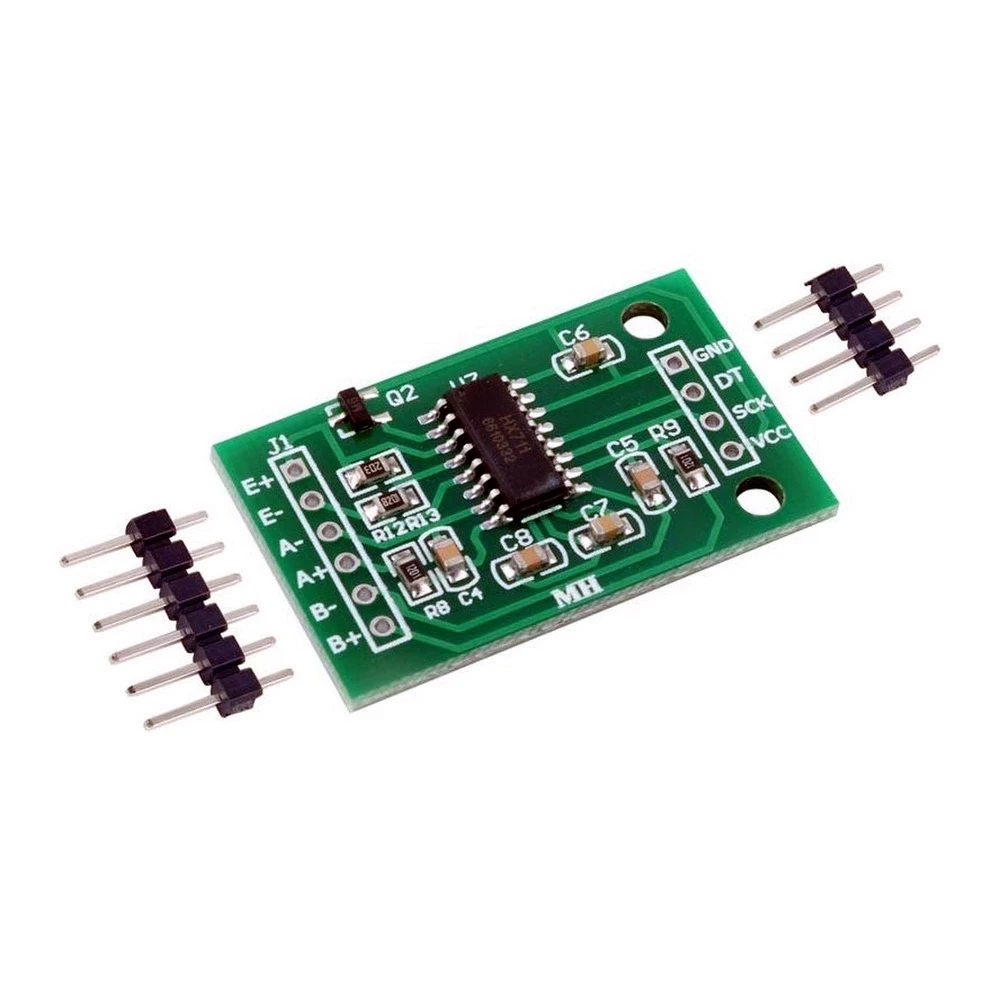
Das HX711 Wägezellenmodul Arduino ist ein Analog-Digital-Wandlermodul (A/D), das für hochpräzise Anwendungen zur Messung von Gewicht und Druck entwickelt wurde. Dieses Modul verwendet einen 24-Bit-Wandlerchip, der exakte und zuverlässige Messwerte ermöglicht und sich ideal für Projekte mit Arduino und anderen Mikrocontrollern eignet.
Dieses Modul verfügt über zwei auswählbare differentielle analoge Eingangskanäle, sodass sich verschiedene Drucksensoren oder Wägezellen anschließen lassen. Es integriert einen programmierbaren Verstärkungsfaktor (PGA) mit den Verstärkungsoptionen 32, 64 und 128, was die Empfindlichkeit und Genauigkeit der Messungen verbessert.
Hauptmerkmale:
- Zwei differentielle Eingangskanäle für flexible Sensorsysteme.
- Rauschärmer aktiver PGA-Verstärker mit auswählbarer Verstärkung (32, 64, 128).
- Integrierter Spannungsregler für ADC und Wägezelle.
- Interner Oszillator ohne externe Bauteile erforderlich, mit Option für externen Quarz.
- Automatischer Reset beim Einschalten des Moduls.
- Einfache serielle Digitalschnittstelle, per Pins gesteuert, ohne komplexe Programmierung.
- Wählbare Ausgangsrate: 10 Samples pro Sekunde (SPS) oder 80 SPS.
- Gleichzeitige Unterdrückung von 50- und 60-Hz-Störungen für mehr Stabilität.
- Niedriger Stromverbrauch: weniger als 1.5 mA im Normalbetrieb.
- Betriebsspannungsbereich: 2.6 V bis 5.5 V, kompatibel mit Arduino.
- Betriebstemperaturbereich: -20 °C bis +85 °C.
Typische Anwendungen:
- Entwurf und Aufbau hochpräziser elektronischer Waagen.
- Druckmessung mit Brückensensoren.
- Elektronik- und Robotikprojekte mit Arduino, die eine präzise analoge Messung erfordern.
- Integration in industrielle Steuerungs- und Überwachungssysteme.
Dieses Modul ist mit Arduino-Boards und anderen Mikrocontrollern kompatibel, die serielle digitale Kommunikation unterstützen. Der niedrige Preis und die hohe Genauigkeit machen es zu einer ausgezeichneten Wahl für Entwickler und Hobbyanwender, die einen zuverlässigen Wäge- und Drucksensor suchen.
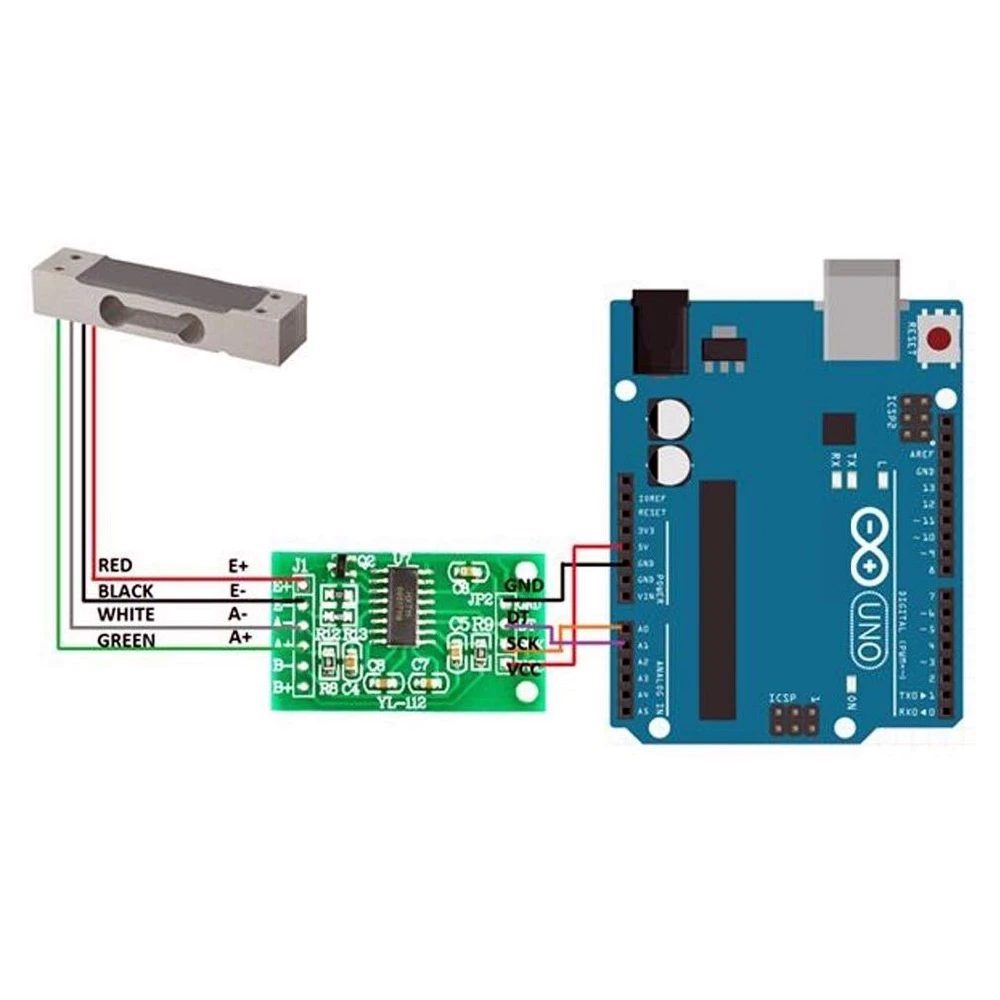
Für den Einsatz wird empfohlen, die Wägezelle oder den Drucksensor an die differentiellen Eingänge anzuschließen und das Modul mit einer Spannung innerhalb des angegebenen Bereichs zu versorgen. Der digitale Messwert kann über kompatible Arduino-Bibliotheken ausgelesen werden, die die Integration und Programmierung erleichtern.
- Zwei auswählbare differentielle analoge Eingangskanäle
- Rauschärmer PGA-Verstärker mit programmierbarer Verstärkung 32, 64, 128
- Integrierter Spannungsregler für ADC und Wägezelle
- Interner Oszillator ohne externe Bauteile erforderlich
- Einfache serielle Digitalschnittstelle, ohne komplexe Programmierung
- Wählbare Ausgangsrate: 10 SPS oder 80 SPS
- Unterdrückung von 50- und 60-Hz-Störungen gleichzeitig
- Niedriger Verbrauch: weniger als 1.5 mA im Normalbetrieb
- Spannungsbereich: 2.6 bis 5.5 V, kompatibel mit Arduino
- Temperaturbereich: -20 °C bis +85 °C
Kundenfragen & Antworten
Quins són els principals avantatges del sensor HX711 davant d’altres mòduls de pesatge A/D per a Arduino?
El HX711 destaca pel seu convertidor A/D de 24 bits de precisió, que permet obtenir mesures més sensibles i estables en comparació amb mòduls de menor resolució (com els de 12 o 16 bits). El seu doble canal diferencial facilita aplicacions de doble cèl·lula i el guany programable (128 i 64) ofereix flexibilitat per a diferents rangs de càrrega. A més, integra un regulador de voltatge i un oscil·lador intern, simplificant el circuit i reduint el cost en comparació amb alternatives que requereixen components externs.
Quines consideracions d’instal·lació he de tenir per obtenir mesures precises amb aquest sensor?
Per a mesures òptimes, es recomana col·locar el mòdul sobre una superfície estable, minimitzar les interferències electromagnètiques i cablejar amb conductors curts i trenats entre el HX711 i la cèl·lula de càrrega. És important connectar una sola font d’alimentació compartida amb el microcontrolador per evitar sorolls i fer calibracions periòdiques del sistema segons l’entorn i la cèl·lula utilitzada.
Quins són els límits de precisió i possibles fonts d’error en l’ús del HX711?
El HX711 ofereix una resolució teòrica de fins a 24 bits, però a la pràctica el seu error típic és d’entre 1-2 μV/bit i la precisió depèn molt de la qualitat de la cèl·lula de càrrega, el soroll elèctric, el guany seleccionat i la velocitat de mostreig (10SPS millora el soroll respecte a 80SPS). Les fonts d’error habituals inclouen fluctuacions tèrmiques, alimentació inestable i mala connexió dels cables. És recomanable aïllar bé el sistema i calibrar-lo en l’entorn real d’ús.
What are the main advantages of the HX711 sensor compared with other A/D weighing modules for Arduino?
The HX711 stands out for its 24-bit precision A/D converter, which allows more sensitive and stable measurements compared with lower-resolution modules (such as 12- or 16-bit ones). Its dual differential channel makes dual-cell applications easier, and the programmable gain (128 and 64) offers flexibility for different load ranges. It also integrates a voltage regulator and internal oscillator, simplifying the circuit and reducing cost compared with alternatives that require external components.
What installation considerations should I keep in mind to obtain accurate measurements with this sensor?
For optimum measurements, it is recommended to place the module on a stable surface, minimise electromagnetic interference and use short, twisted conductors between the HX711 and the load cell. It is important to connect a single shared power supply with the microcontroller to avoid noise and to carry out periodic calibration of the system according to the environment and the load cell used.
What are the accuracy limits and possible sources of error when using the HX711?
The HX711 offers a theoretical resolution of up to 24 bits, but in practice its typical error is between 1–2 μV/bit and accuracy depends heavily on the quality of the load cell, electrical noise, selected gain and sampling rate (10 SPS improves noise compared with 80 SPS). Common sources of error include thermal fluctuations, unstable power supply and poor cable connections. It is advisable to isolate the system properly and calibrate it in the real operating environment.
What are the main advantages of the HX711 sensor compared with other A/D load cell modules for Arduino?
The HX711 stands out for its 24-bit precision A/D converter, which allows more sensitive and stable measurements compared with lower-resolution modules (such as 12- or 16-bit ones). Its dual differential channel supports dual-cell applications, and the programmable gain (128 and 64) offers flexibility for different load ranges. It also integrates a voltage regulator and internal oscillator, simplifying the circuit and reducing cost compared with alternatives that require external components.
What installation considerations should I keep in mind to obtain accurate measurements with this sensor?
For optimum measurements, it is recommended to place the module on a stable surface, minimise electromagnetic interference and use short, twisted conductors between the HX711 and the load cell. It is important to use a single shared power supply with the microcontroller to avoid noise and to carry out periodic calibration of the system according to the environment and the load cell used.
What are the accuracy limits and possible sources of error when using the HX711?
The HX711 offers a theoretical resolution of up to 24 bits, but in practice its typical error is between 1–2 μV/bit and accuracy depends heavily on the quality of the load cell, electrical noise, selected gain and sampling rate (10SPS improves noise compared with 80SPS). Common sources of error include thermal fluctuations, unstable power supply and poor cable connections. It is advisable to isolate the system properly and calibrate it in the real operating environment.
Vilka är de främsta fördelarna med HX711-sensorn jämfört med andra A/D-vågmoduler för Arduino?
HX711 utmärker sig med sin 24-bitars A/D-omvandlare, vilket ger känsligare och stabilare mätningar jämfört med moduler med lägre upplösning (som 12 eller 16 bitar). Dess dubbla differentiella kanal underlättar tillämpningar med dubbla celler och den programmerbara förstärkningen (128 och 64) ger flexibilitet för olika lastområden. Dessutom integrerar den en spänningsregulator och intern oscillator, vilket förenklar kretsen och minskar kostnaden jämfört med alternativ som kräver externa komponenter.
Kundenbewertung schreiben
Kunden, die diesen Artikel gekauft haben, kauften auch




Ihre zuletzt angesehenen Artikel
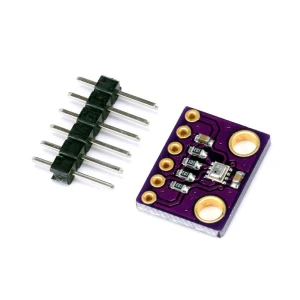
BMP280 Sensor für Arduino zur Messung von Luftdruck und Temperatur mit I2C
2,86€
Nur noch 9 auf Lager
 HX711 Wägezellenmodul Arduino - 24Bit Dual-Channel A/D
2,38€