


11,90€
Auf Lager

Grünes LCD 20x4 Zeichen mit Serial IIC/I2C für Arduino
Marke: satkit
11,90€
Inkl. MwSt. (Exkl. MwSt.: 10,00€)
Begrenzter Vorrat
Standardlieferung
Mi, Apr 22 - Fr, Apr 24
Expresslieferung
Mo, Apr 20 - Di, Apr 21
30 Tage Rückgaberecht
Kostenlose Rücksendung innerhalb von 30 Tagen
Sichere Transaktion






Share:
Kostenlose Lieferung
Bei Bestellungen ab 300€
Einfache Rücksendung
30 Tage Rückgaberecht
Sichere Zahlung
100% sicherer Checkout
Qualitätsgarantie
Nur Originalprodukte
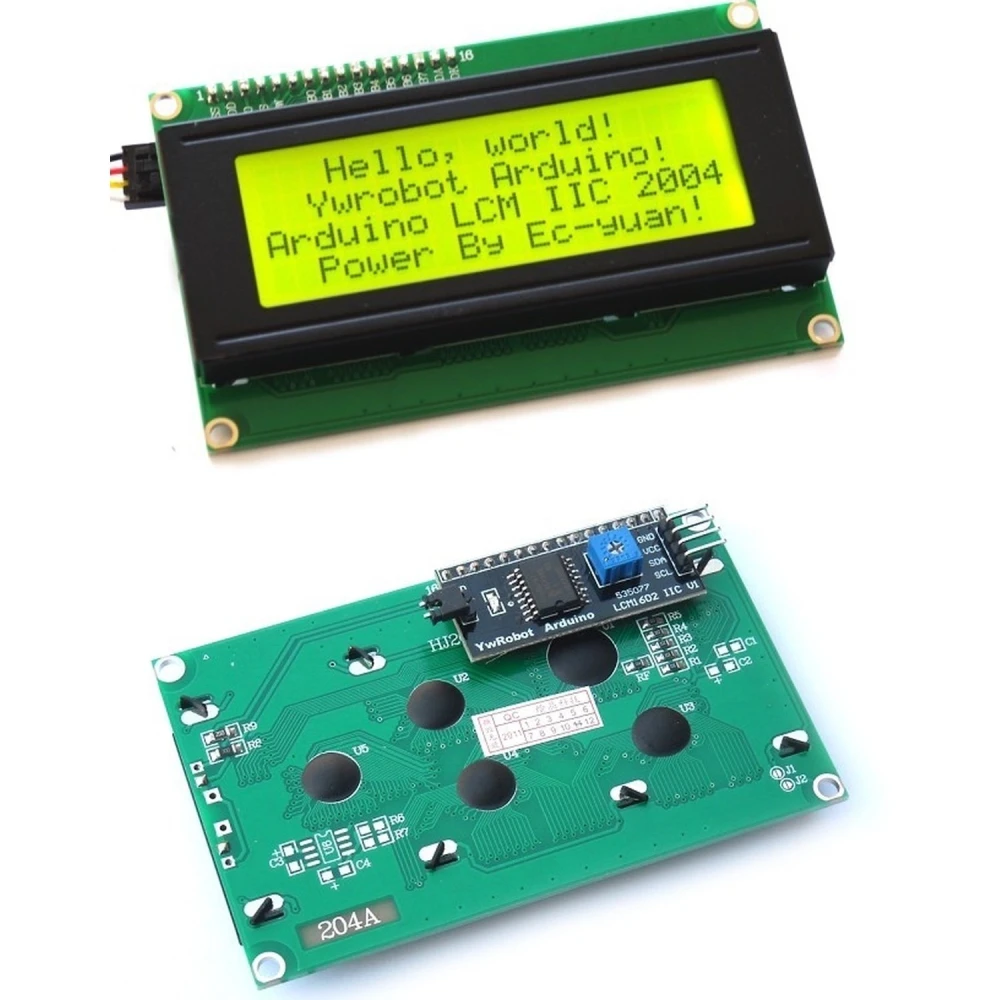
Das LCD Verde 20x4 Caracteres con Serial IIC/I2C para Arduino ist ein FSTN-LCD-Display, das bis zu 4 Zeilen mit jeweils 20 Zeichen anzeigen kann und damit eine klare und effiziente Darstellung für Ihre Elektronikprojekte bietet. Mit weißer Hintergrundbeleuchtung auf grünem Hintergrund sorgt dieses Display auch bei wenig Licht für eine sehr gute Sichtbarkeit.
Dank der I2C-Kommunikationsschnittstelle vereinfacht dieses Modul den Anschluss an Arduino-Boards und benötigt nur vier Pins: GND, VCC, SDA und SCL, wodurch die Verdrahtung reduziert und die Integration in Ihre Projekte erleichtert wird.
Hauptmerkmale:
- Schnittstelle: I2C für einen einfachen und schnellen Anschluss.
- I2C-Adresse: 0x27, kompatibel mit den meisten Arduino-Bibliotheken.
- Hintergrundbeleuchtung: Grün mit weißer Beleuchtung inklusive, ohne zusätzliche Komponenten.
- Versorgung: 5V für Kompatibilität mit Standard-Arduino-Boards.
- Größe: 60mm x 99mm, kompakt und leicht zu integrieren.
- Kontrasteinstellung: Über integriertes Potentiometer für eine optimale Anzeige.
- Hintergrundbeleuchtungseinstellung: Über Jumper steuerbar zur individuellen Anpassung der Beleuchtung.
Typische Anwendungen:
Dieses LCD eignet sich ideal für Arduino-Projekte, bei denen Informationen wie Sensordaten, Menüs, Systemzustände oder beliebige Texte klar und gut lesbar angezeigt werden sollen. Der geringe Stromverbrauch und die einfache Installation machen es perfekt für Prototypen, Embedded-Systeme und tragbare Geräte.
Kompatibilität:
Kompatibel mit den meisten Arduino-Boards, die I2C-Kommunikation unterstützen, ist dieses Modul eine praktische Lösung für Entwickler und Bastler, die ein zuverlässiges und einfach zu bedienendes Display suchen.
- FSTN-LCD-Display mit 4 Zeilen und 20 Zeichen pro Zeile
- I2C-Schnittstelle mit Adresse 0x27 für einfachen Anschluss
- Grüne Hintergrundbeleuchtung mit weißem Licht inklusive
- 5V-Versorgung, kompatibel mit Arduino
- Kompakte Größe von 60mm x 99mm
- Kontrasteinstellung über Potentiometer
- Steuerung der Hintergrundbeleuchtung über Jumper
Kundenfragen & Antworten
Quins avantatges ofereix l’ús de la interfície I2C en aquesta pantalla LCD respecte a una connexió paral·lela estàndard?
La interfície I2C redueix significativament la quantitat de pins necessaris per a la connexió (només SDA i SCL, a més de VCC i GND), i permet alliberar pins en microcontroladors com Arduino. En comparació amb les connexions paral·leles, que requereixen almenys 6-7 pins de dades i control, I2C millora l’escalabilitat i l’organització del cablejat, tot i que la velocitat d’actualització pot ser lleugerament inferior a causa del protocol sèrie.
Quines són les dimensions i el pes exactes del mòdul LCD, i quins elements s’inclouen a la caixa?
El mòdul LCD fa 99 mm d’amplada per 60 mm d’alçada; el pes típic ronda els 75 g. El paquet estàndard només inclou el mòdul muntat (pantalla i placa controladora amb I2C), sense cables ni altres accessoris.
Amb quins microcontroladors i versions d’Arduino és totalment compatible aquest display fent servir la interfície I2C i l’adreça 0x27?
El display és compatible amb la majoria de plaques Arduino (Uno, Mega, Nano, Leonardo) i microcontroladors amb bus I2C estàndard (com ESP8266, ESP32, STM32, Raspberry Pi). Cal utilitzar una llibreria adequada (per exemple, LiquidCrystal_I2C). Confirmeu que l’adreça I2C 0x27 no estigui ocupada per un altre dispositiu al bus.
What advantages does using the I2C interface on this LCD display offer compared with a standard parallel connection?
The I2C interface significantly reduces the number of pins required for the connection (only SDA and SCL, plus VCC and GND), freeing up pins on microcontrollers such as Arduino. Compared with parallel connections, which require at least 6-7 data and control pins, I2C improves scalability and cable management, although refresh speed may be slightly lower due to the serial protocol.
What are the exact dimensions and weight of the LCD module, and what items are included in the box?
The LCD module measures 99 mm wide by 60 mm high; the typical weight is around 75 g. The standard package includes only the assembled module (display and controller board with I2C), with no cables or other accessories.
Which microcontrollers and Arduino versions is this display fully compatible with when using the I2C interface and address 0x27?
The display is compatible with most Arduino boards (Uno, Mega, Nano, Leonardo) and microcontrollers with a standard I2C bus (such as ESP8266, ESP32, STM32, Raspberry Pi). You need to use an appropriate library (e.g. LiquidCrystal_I2C). Make sure the I2C address 0x27 is not already in use by another device on the bus.
What advantages does using the I2C interface on this LCD display offer compared with a standard parallel connection?
The I2C interface significantly reduces the number of pins required for the connection (only SDA and SCL, plus VCC and GND), freeing up pins on microcontrollers such as Arduino. Compared with parallel connections, which require at least 6-7 data and control pins, I2C improves scalability and cable management, although refresh speed may be slightly lower due to the serial protocol.
What are the exact dimensions and weight of the LCD module, and what items are included in the box?
The LCD module measures 99 mm wide by 60 mm high; the typical weight is around 75 g. The standard package includes only the assembled module (display and controller board with I2C), with no cables or other accessories.
Which microcontrollers and Arduino versions are fully compatible with this display using the I2C interface and address 0x27?
The display is compatible with most Arduino boards (Uno, Mega, Nano, Leonardo) and microcontrollers with a standard I2C bus (such as ESP8266, ESP32, STM32, Raspberry Pi). You need to use a suitable library (e.g. LiquidCrystal_I2C). Make sure the I2C address 0x27 is not already in use by another device on the bus.
Vilka fördelar ger användningen av I2C-gränssnittet på denna LCD-skärm jämfört med en standard parallell anslutning?
I2C-gränssnittet minskar antalet pinnar som behövs för anslutningen avsevärt (endast SDA och SCL, samt VCC och GND), vilket frigör pinnar på mikrokontroller som Arduino. Jämfört med parallella anslutningar som kräver minst 6–7 data- och styrpinnar förbättrar I2C skalbarheten och kabeldragningens ordning, även om uppdateringshastigheten kan vara något lägre på grund av serieprotokollet.
Kundenbewertung schreiben
Kunden, die diesen Artikel gekauft haben, kauften auch




Ihre zuletzt angesehenen Artikel



 Grünes LCD 20x4 Zeichen mit Serial IIC/I2C für Arduino
11,90€